English
 hrvatski
 українська
 Français
 magyar
 suomi
suomi slovenčina
 Kreyòl Ayisyen
 русский
  íslenska
 Eesti
Eesti Čeština


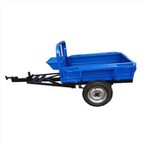
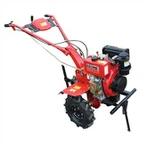
Walk-behind tractors are divided into 3 grades according to the power of 2.2 kilowatts or less, 2.2 to 4.5 kilowatts, and 5 to 13 kilowatts. According to the work performance, it can be divided into driving type, traction type and driving traction type. The drive type is mainly equipped with rotary tillers, so it is also called power tillers; the traction type is mainly matched with traction farm tools; the dual-purpose type can be matched with rotary tillers (see picture), as well as traction farm tools or trailers. transport work. According to the walking device, it is divided into wheel type, crawler type and tillage type. Wheeled walk tractors are divided into single wheel and double wheel according to the number of walking wheels.
In order to improve the working conditions of drivers, walking tractors produced in China add 1 to 2 supporting wheels and install seats to become riding tractors; cultivating walking tractors are also called wheelless walking tractors, which are characterized by no driving wheels. Instead, a rotary tillage component is installed on the drive shaft, which not only tills the soil but also moves forward. Mechanical structure Walking tractor is generally composed of frame, power unit, transmission system, walking device, steering system, brake and control mechanism.
walking tractor
The horizontal single-cylinder diesel engine is mostly used. The power of the engine is transmitted to the drive train by the V-belt, and the speed of the power is controlled by the clutch. The power is transmitted to the gearbox through the chain transmission case, and the central drive, final drive, steering mechanism and brakes are all installed in the gearbox. The gearbox adopts gear transmission, and the gears vary according to the type. Generally, it is 6 plus 2 gears (that is, 6 forward gears and 2 reverse gears), at least 3 plus 1 gears, and up to 12 plus 6 gears. The power after shifting is transmitted to the drive wheels on both sides by the central drive and the final drive. The steering mechanism adopts a jaw clutch or a copper ball clutch.
The operating mechanism is mounted on the handrail to control the throttle, shifting, steering, braking and power output. The power is directly output from the power take-off shaft or the engine through gears. In order to meet the needs of paddy field operation, the traveling device is equipped with various iron impellers in addition to tires, and is also equipped with a tail wheel. There are two types of tail wheels: transport wheels and tilling wheels. The former is used to support the weight and assist steering; the latter is used to adjust the tillage depth. The skid can be used instead when working in paddy fields.